The Knoedler Gallery Forgery Scandal
How America's oldest art gallery sold more than $80 million in fake masterpieces
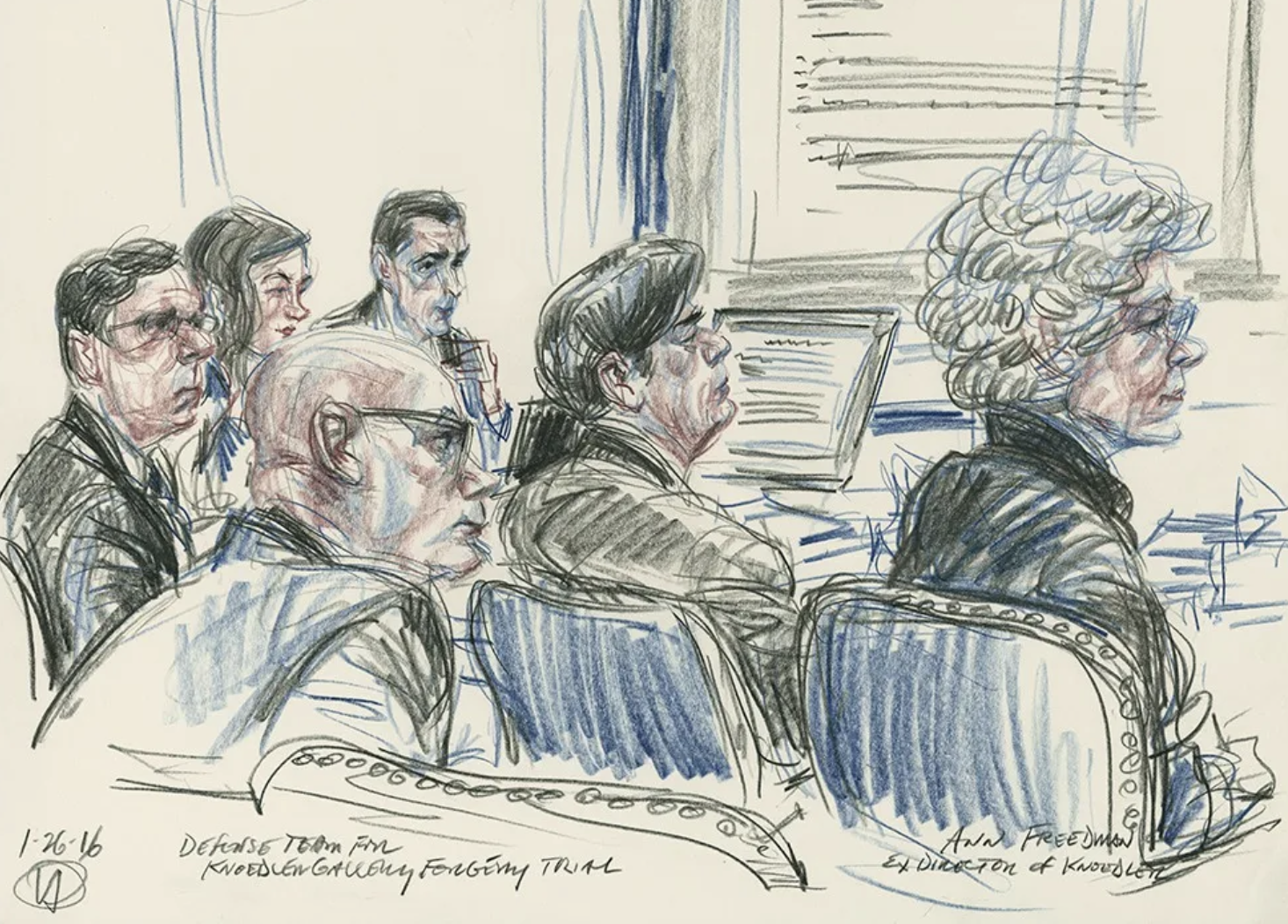
For over 15 years, the venerable Knoedler gallery sold some 40 forged Abstract Expressionist paintings — fake Rothkos, Pollocks, and de Koonings painted in a Queens garage — for around $80 million, before the fraud collapsed the 165-year-old institution.
For 165 years, the Knoedler Gallery was one of the most respected names in the art world. Founded in New York in 1846, it had helped shape some of America's greatest collections, selling works by Old Masters, Impressionists, and the giants of modern art. Collectors trusted Knoedler because of its reputation. That reputation would ultimately become its greatest liability. Between 1994 and 2011, the gallery sold dozens of paintings that were claimed to be previously unknown masterpieces by Jackson Pollock, Mark Rothko, Robert Motherwell, Willem de Kooning, Franz Kline, and other Abstract Expressionist legends. Buyers included hedge fund managers, collectors, and prestigious institutions, many of whom paid millions of dollars for works they believed were extraordinary discoveries. The paintings all came from a single source. Long Island art dealer Glafira Rosales told Knoedler president Ann Freedman that the works originated from the secret collection of an anonymous European businessman whose family wished to remain private. The story was unusual. The paintings had no documented exhibition history, no published provenance, and no appearance in the artists' catalogues raisonnés. Yet many collectors were willing to overlook those gaps, persuaded by the gallery's reputation and Freedman's confidence in the works. Behind the scenes, the paintings were anything but lost masterpieces. The forgeries were created in a modest garage in Queens by Chinese immigrant Pei-Shen Qian, a talented painter who possessed an extraordinary ability to imitate the styles of Abstract Expressionist masters. Working from books and reproductions, Qian recreated the sweeping gestures of Pollock, the luminous color fields of Rothko, and the expressive brushwork of Motherwell with remarkable skill. To make the paintings appear old, he reportedly stained canvases with tea, dirt collected from vacuum cleaners, and other household materials before delivering them to Rosales. Qian earned as little as a few hundred dollars—and rarely more than $9,000—for each painting. Rosales sold the same works to Knoedler for hundreds of thousands of dollars. Knoedler, in turn, sold them to collectors for millions. Over seventeen years, nearly forty forged paintings passed through the gallery, generating more than $80 million in sales. Questions slowly began to emerge. In 2003, Goldman Sachs executive Jack Levy purchased a purported Jackson Pollock for $2 million. When the International Foundation for Art Research declined to authenticate the painting, Levy returned it and received a full refund. Similar concerns surfaced among scholars who noted the absence of convincing provenance and the reluctance of artist foundations to endorse the works. Scientific testing would eventually deliver the most damaging evidence. One painting attributed to Pollock was found to contain pigments that had not been manufactured until years after the artist's death in 1956. No amount of provenance—or persuasion—could overcome chemistry. As lawsuits mounted, the gallery's carefully constructed narrative began to collapse. In October 2009, gallery president Ann Freedman resigned. Although she consistently maintained that she had believed the paintings were genuine, collectors accused the gallery of ignoring obvious warning signs in its pursuit of extraordinary discoveries. On November 28, 2011, Knoedler announced it was closing after 165 years in business, citing business reasons. Few observers believed the timing was coincidental. Federal investigators soon uncovered the full scope of the scheme. In 2013, Glafira Rosales pleaded guilty to wire fraud, money laundering, tax evasion, and selling more than sixty forged artworks through New York galleries. She later agreed to forfeit millions of dollars and cooperate with investigators, ultimately receiving a reduced sentence because of her assistance. Rosales' boyfriend, Spanish art dealer José Carlos Bergantiños Díaz, and his brother Jesús Ángel Bergantiños Díaz were also indicted for their alleged roles in the conspiracy. Extradition proceedings stretched on for years in Spain. The mastermind behind the paintings themselves, Pei-Shen Qian, was indicted in the United States but fled to China before he could be arrested. Because China generally does not extradite its citizens to the United States, he has never faced trial there. The scandal continues to raise uncomfortable questions that extend far beyond one gallery. How could experienced dealers, sophisticated collectors, and respected experts all be persuaded by paintings with little documented history? Did the prestige of Knoedler discourage skepticism? And how much responsibility should a gallery bear when selling works that cannot be conclusively authenticated? More than a decade later, the Knoedler affair remains one of the defining fraud cases in the history of the art market. It exposed weaknesses in provenance research, the limitations of connoisseurship, and the enormous financial incentives surrounding "lost masterpieces." It also demonstrated how reputation—no matter how longstanding—can never substitute for evidence. Today, the scandal is the subject of two acclaimed documentaries: Made You Look: A True Story About Fake Art (2020), directed by Barry Avrich, and Driven to Abstraction (2019), directed by Daria Price. Both explore not only the mechanics of the forgery scheme, but also the psychology of belief in the art world.