Tony Labat's 'Kidnap Attempt'
A staged abduction of a public official as political performance
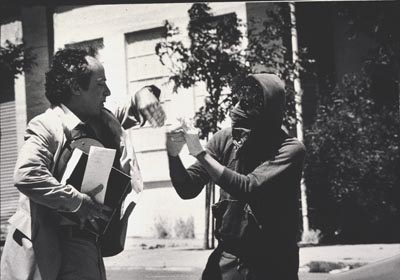
Image: courtesy / press
In 1978, Tony Labat and Mike Osterhout staged the attempted kidnapping of a public official as a work of political performance art — an intervention in public space that deliberately blurred the line between art, protest, and crime. The action ultimately failed.
Conceived not as a real abduction but as a critique of political power and media spectacle, 'Kidnap Attempt' saw Labat disguise himself and approach a targeted politician, intending to momentarily 'seize' the official as the substance of the piece. The plan collapsed almost immediately — security and the unpredictable realities of confronting an actual public figure prevented the action from unfolding. As one account puts it simply: 'Ultimately, the action failed.' No one was harmed, and no abduction occurred.
The work emerged from the politically charged California performance scene of the 1970s, when artists such as Chris Burden, Suzanne Lacy, and ASCO were moving art into public life and challenging authority. It questioned who holds power in public space, the supposed invulnerability of political figures, how media turns events into spectacle, and where the line lies between art, protest, and criminal behaviour.
Rather than a prank, it was intended as a critique of political systems and public perception, and is often discussed alongside the interventionist work of Mexican collectives such as Los Grupos, who likewise blurred activism and performance. Its significance today lies less in the event than in the questions it raised — and in its uneasy place on the border between an artwork and a genuine crime.